
What Are the 7 C's of Logistics?
In logistics, moving a product from one location to another is only part of the job. Customers expect the right product, in the right condition, at the right time, with accurate information and reasonable costs. This is where the 7 C’s of logistics provide a practical framework. They help businesses understand what an effective logistics operation should deliver and how each stage of the supply chain contributes to customer satisfaction.
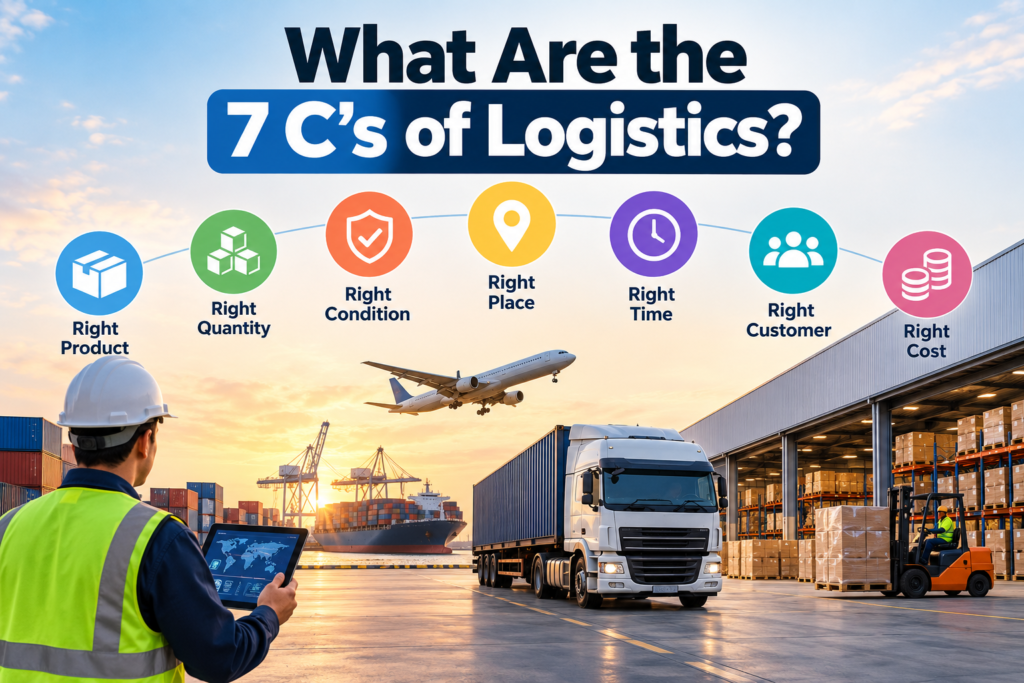
The 7 C’s generally refer to delivering the right product, right quantity, right condition, right place, right time, right customer, and right cost. When these elements work together, logistics becomes more predictable, efficient, and customer-focused.
What Are the 7 C’s of Logistics?
The 7 C’s are a simple way to evaluate whether a logistics process is meeting its fundamental objectives. Let’s examine each one.
1. Right Product
The first C is delivering the right product. A shipment is successful only when the item ordered by the customer matches the item delivered.
Accurate inventory records, barcode scanning, warehouse organization, and proper order-picking procedures can reduce product-selection errors. For example, sending the wrong model, size, color, or SKU can result in returns and additional delivery expenses.
2. Right Quantity
The second C focuses on delivering the right quantity. Customers should receive exactly what they ordered unless a substitution or adjustment has been approved.
Warehouse management systems and automated inventory tracking can help businesses maintain accurate stock levels. Quantity errors may appear small, but repeated shortages or excess shipments can affect customer trust and operating costs.
3. Right Condition
Products must reach their destination in the right condition. This becomes particularly important for fragile goods, electronics, pharmaceuticals, food, and other sensitive products.
Appropriate packaging, handling procedures, temperature control, protective materials, and careful transportation can help prevent damage. Logistics teams should also document damaged shipments and investigate recurring causes rather than treating every incident as an isolated problem.
4. Right Place
The fourth C is delivering goods to the right place. A shipment arriving on schedule is not useful if it reaches the wrong warehouse, store, office, or customer address.
Address validation, GPS-enabled tracking, route planning, and delivery confirmation can improve location accuracy. For businesses operating across multiple cities, strong last-mile coordination is especially important.
5. Right Time
Timing is central to logistics. The right time means delivering a shipment within the agreed delivery window.
Customers increasingly expect predictable delivery rather than simply fast delivery. Businesses can improve reliability through demand forecasting, route optimization, shipment tracking, inventory planning, and better coordination between warehouses and transportation partners.
6. Right Customer
The shipment must reach the right customer. This sounds obvious, but customer identification errors can occur when addresses, order numbers, names, or contact details are inaccurate.
Delivery verification, OTP-based confirmation, digital proof of delivery, and accurate customer databases can reduce these problems. The objective is not simply to complete a delivery, but to ensure that it is completed for the intended recipient.
7. Right Cost
The final C is the right cost. Logistics should provide reliable service without creating unnecessary expenses.
Businesses need to balance transportation costs, warehousing expenses, packaging, labor, fuel, technology, and inventory carrying costs against service expectations. The cheapest option is not always the most efficient. A slightly higher transportation cost may sometimes prevent delays, product damage, or expensive returns.
Why Are the 7 C’s Important in Logistics?
The 7 C’s help organizations look at logistics from the customer’s perspective. Instead of measuring success only by transportation speed or shipment volume, businesses can evaluate the entire delivery experience.
Consider a simple example. A retailer once dispatched an urgent order using an express carrier. The package left the warehouse on schedule and reached the correct city, but the product was damaged because it had been packed without sufficient protection. The delivery was technically fast, yet the customer still had a poor experience.
This anecdote highlights an important point: logistics performance depends on multiple connected factors. Improving one area while ignoring another can still produce an unsuccessful delivery.
The 7 C’s can help businesses:
Reduce order and delivery errors
Improve customer satisfaction
Control logistics expenses
Minimize product damage
Improve inventory accuracy
Strengthen delivery reliability
Create more consistent supply chain processes
For companies working with logistics partners, reviewing these seven principles can also make vendor evaluation more structured.
How Can Businesses Apply the 7 C’s?
Applying the 7 C’s does not necessarily require complicated technology from day one. Businesses can begin by mapping their existing logistics process and identifying where errors occur.
A practical approach is:
Audit order accuracy: Check whether the correct products and quantities are being picked.
Review packaging: Identify products that frequently arrive damaged.
Measure delivery performance: Track on-time delivery percentages.
Verify addresses: Use standardized customer and delivery information.
Monitor logistics costs: Compare transportation, warehousing, and handling expenses.
Track customer feedback: Look for repeated complaints or delivery issues.
Use technology: Introduce inventory management, GPS tracking, barcode scanning, and digital proof of delivery where appropriate.
From an E-E-A-T perspective, reliable logistics decisions should be based on measurable operational data rather than assumptions. Businesses should regularly review KPIs such as order accuracy, delivery success rate, damage rate, return rate, inventory accuracy, and cost per shipment.
A logistics provider such as Ryzonic can support businesses by helping coordinate transportation, warehousing, fulfillment, and other supply chain requirements around practical service objectives.
7 C’s of Logistics: Quick Summary
| C | Meaning |
|---|---|
| Right Product | Deliver the item ordered |
| Right Quantity | Deliver the correct number of items |
| Right Condition | Prevent damage and maintain quality |
| Right Place | Deliver to the correct destination |
| Right Time | Meet the agreed delivery window |
| Right Customer | Deliver to the intended recipient |
| Right Cost | Maintain an appropriate logistics cost |
Together, these principles create a useful checklist for evaluating logistics performance.
FAQs-
1. What are the 7 C’s of logistics?
The 7 C’s are the right product, right quantity, right condition, right place, right time, right customer, and right cost. They describe the key requirements of effective logistics.
2. Why are the 7 C’s important?
They help businesses evaluate whether their logistics operations are accurate, timely, cost-effective, and customer-focused.
3. Are the 7 C’s useful for small businesses?
Yes. Small businesses can use them as a simple checklist for inventory, packaging, transportation, delivery, and customer service.
4. How can technology support the 7 C’s?
Inventory software, barcode systems, GPS tracking, route optimization, order management platforms, and digital proof of delivery can improve visibility and accuracy.
5. Can a logistics company help implement the 7 C’s?
Yes. A professional logistics partner can help businesses manage transportation, warehousing, fulfillment, tracking, and delivery processes while focusing on service quality and cost control.
Final Thoughts
The 7 C’s of logistics offer a straightforward way to understand what customers expect from a successful supply chain. Getting the product, quantity, condition, place, time, customer, and cost right can reduce operational mistakes while improving the overall delivery experience.
For growing businesses, the key is to treat logistics as an integrated process rather than a simple transportation activity. By measuring performance consistently and improving weak points, companies can build a more reliable and scalable supply chain.
If your business needs support with transportation, warehousing, fulfillment, or end-to-end logistics planning, Ryzonic can help you explore practical solutions designed around your operational requirements. Get in touch to discuss your logistics needs and build a delivery process focused on accuracy, reliability, and efficiency.